
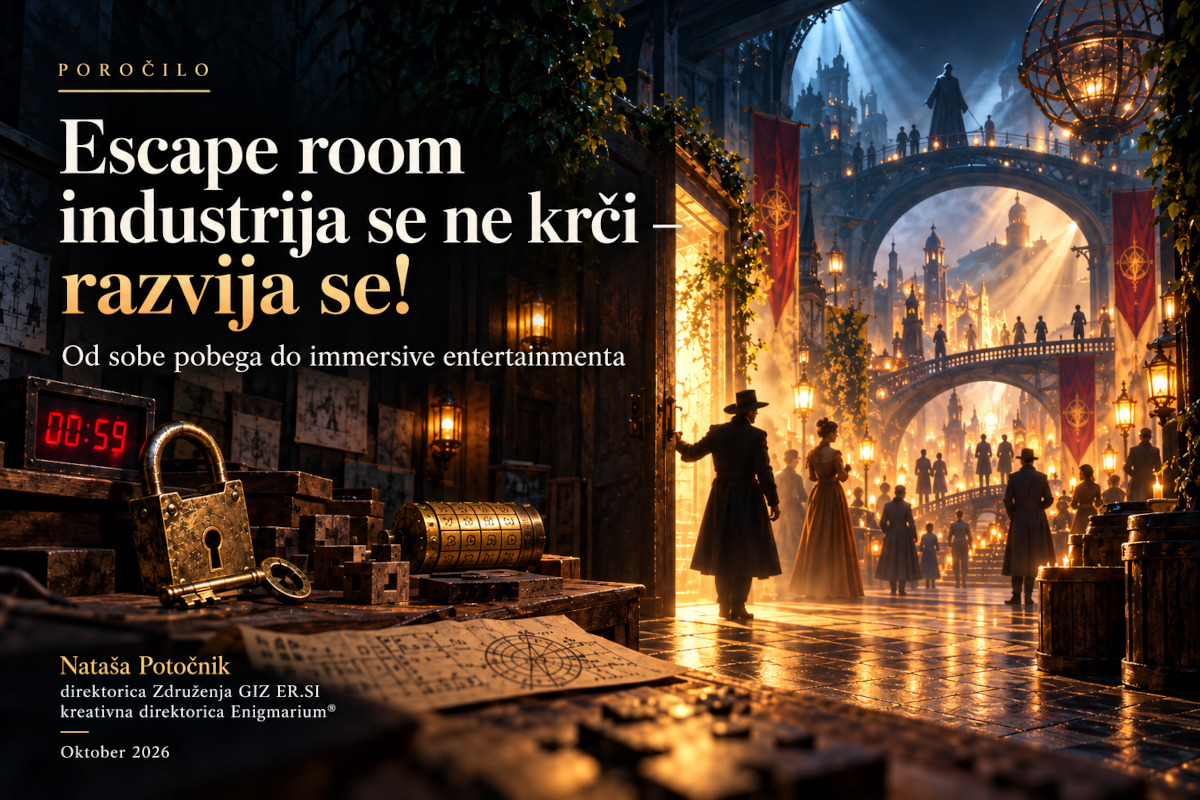
Nataša Potočnik
Director of the Slovenian Escape Room Association (GIZ ER.SI)
Creative Director of Enigmarium®
October 2026
The Escape Room Industry Is Not Shrinking – It Is Evolving into Immersive Entertainment
From a single room, sixty minutes and a collection of locks to cinematic sets, interactive theatre and multi-hour adventures that inspire visitors to travel across national borders. The escape room industry is entering a new stage of development. US data indicates a stabilising market and changing business models, while similar shifts are becoming increasingly visible across Europe. What does this mean for Slovenia, and what opportunities does it create for local operators?
The US Market Is Stable, but the Industry Is Changing
At the end of December 2025, Room Escape Artist published a new report on the state of the US escape room industry. The data paints an interesting picture: after a decade of extraordinary growth, market changes, closures and post-pandemic adjustments, the number of locations has stabilised. But this certainly does not mean that the industry has stopped evolving.
The United States currently has just over 2,000 physical escape room locations, offering approximately 7,800 individual games. The average location offers 3.8 games, while approximately 1,450 companies or affiliated operators stand behind these businesses.
The number of locations has remained relatively unchanged for more than three years. At the same time, ownership structures and product offerings are evolving. The report highlights two particularly important trends: ownership consolidation and the expansion of business models into other forms of interactive and experiential entertainment.
An increasing number of locations are operated by companies managing multiple venues, franchises or related brands. Alongside traditional escape rooms, operators are developing new formats, including challenge arcades, murder mystery events, quizzes, special events and other forms of active entertainment.
According to estimates in the same report, the US market generates approximately $300 million in annual revenue. This is an estimate based on booking volumes and average transaction values, rather than a direct measurement of total industry turnover.
The important message behind these figures is that escape rooms were not a passing fad. The industry has survived its initial boom, a period of exceptionally rapid expansion, saturation in certain markets and the pandemic.
Today, it is simply different.
Slovenia: A Stable Market and an Association Opening the Door to New Experiences
We are observing a similar development in Slovenia, where the escape room industry began to emerge in 2014.
By the end of that year, the country had six games operated by three providers. In the following years, the number of games increased rapidly before the market gradually stabilised.
According to the current records of the Slovenian Escape Room Association (GIZ ER.SI), Slovenia has 68 registered escape games operated by 16 different providers.
This is an important indicator of the Slovenian market’s maturity. The number of games remains at a relatively similar level to previous years, but their quality, content, production complexity and marketing approaches are changing.
The Slovenian Escape Room Association, which has been connecting Slovenian operators since 2016, continues to strengthen its membership and expand its scope of cooperation. According to its current records, 73.5% of all registered escape games in Slovenia fall under the association’s umbrella.
This means that the association represents a significant part of the Slovenian escape room industry while remaining open to new operators and related forms of gamified and experiential products.
The association’s role is not simply to monitor the number of escape rooms or represent the interests of existing operators. Knowledge sharing, the exchange of best practices, the promotion of quality and safety, professionalisation, and cooperation with tourism, culture, education and other creative industries are becoming increasingly important.
This is also one of the industry’s key development challenges: the question is no longer simply how many escape rooms we have, but what value our experiences create and how we can work together to develop the industry as a whole.
Is “Escape Room” Still the Right Term?
A decade ago, the definition of an escape room was relatively straightforward: one room, one team, sixty minutes, puzzles, locks and a countdown timer.
Today, the same term describes remarkably different products.
On one side, traditional escape rooms remain firmly established. Their core experience revolves around puzzle-solving, logical thinking, observation, communication and teamwork. These are increasingly also described as puzzle rooms or puzzle experiences.
The concept remains attractive and commercially relevant. Many players still enjoy nothing more than cleverly designed puzzles, a sense of progress and the shared satisfaction of successfully solving a challenge.
On the other side, however, experiences are emerging in which the word room has almost lost its meaning.
Productions now occupy entire buildings, industrial warehouses, abandoned structures or purpose-built themed environments. In some cases, creators construct entire streets, villages or imaginary worlds.
Visitors are no longer simply players solving puzzles to unlock an exit. They become explorers, detectives, protagonists or active co-creators of a story. They interact with professional actors, make decisions, respond to unexpected events and influence how their experience unfolds.
As a result, terms such as immersive experience, immersive gaming experience, interactive theatre experience and immersive show are becoming increasingly common across the international industry.
This is not merely a change in terminology. It represents a transformation of the product itself.
Escape rooms are becoming part of a much broader industry of immersive, real-life interactive experiences – immersive entertainment.
From Puzzles to Stories. From Rooms to Worlds. From Games to Experiences.
Perhaps the most significant change lies in what visitors take away from an experience.
In a traditional escape room, players may remember an ingenious puzzle, an unexpected solution or the moment their team finally discovered the correct combination.
In an outstanding immersive production, however, what they often remember most is the feeling of having truly entered another world for a while.
The smell of old wood. The sound of distant footsteps. Lighting that suddenly changes. An actor addressing them as though they genuinely belong in the story. A door opening onto a space they never expected. Or that extraordinary moment when they forget that everything around them is actually a game.
Creating this kind of experience requires much more than a good collection of puzzles.
New competencies and increasingly sophisticated production processes are coming to the forefront: professional set design, custom-built props, sound and lighting design, dramaturgy, direction, live acting, special effects, automation and interactive systems capable of adapting the experience to individual groups.
The most ambitious productions may also feature original musical compositions, complex spatial installations and materials specifically manufactured for a particular project.
However, it is important to emphasise that a larger production budget does not automatically guarantee a better experience. What ultimately matters is the quality of the gameplay flow, the credibility of the story, the meaningful involvement of participants and the creators’ ability to bring all these elements together into one coherent experience.
Puzzles are not disappearing. Their role is changing.
Rather than always being the ultimate objective, they increasingly become tools for advancing the narrative, exploring the environment and creating a genuine sense of participation.
When Creating a Game Takes Years
The evolution of the industry is clearly visible in the increasingly ambitious projects emerging across Europe.
One fascinating example can be found in Sofia, Bulgaria, where a particular experience largely abandons traditional locks and does not feature the usual countdown timer on the wall.
Instead of standard props, visitors enter an environment crafted from iron, stone and wood, featuring unique elements handmade by a blacksmith over a period of more than eight years.
Productions of this kind are difficult to evaluate using the same criteria as a traditional sixty-minute escape room, which also helps explain the higher price of €60 per person.
Visitors are not simply paying for access to puzzles and a room. They are paying to enter an exceptionally crafted world, experience a story and its atmosphere, and feel part of something extraordinary.
Comparisons with theatre performances, concerts, themed attractions or film productions are therefore becoming increasingly relevant.
Three-Hour Games, Live Actors and Entire Themed Villages
These are far from isolated examples, as developments in many European countries demonstrate.
Belgium is becoming known for productions that extend far beyond individual rooms and develop into complete themed worlds. Some environments create the sensation of exploring an actual village or an entirely independent fictional setting.
The Netherlands offers experiences lasting approximately three hours, featuring live actors and journeys between different locations. An entire city can become part of the story.
Spain and Greece have developed particularly strong traditions of intense horror experiences, where interaction with live actors, psychological tension, dramaturgy and direction often take precedence over traditional puzzle-solving.
Canada is also among the most ambitious markets in terms of production values. Canadian creators are developing complex experiences whose sets, visual effects and investment levels approach those of smaller themed attractions.
Slovenia is known for our original gamified museum and castle experiences, which innovatively combine gameplay with authentic history, local legends, and cultural heritage.
Fascinating examples of experiences that go beyond traditional boundaries are emerging around the world. What connects them is a shared ambition: they do not simply want to offer visitors a game, but a complete experience in which visitors themselves play the leading role.
The boundaries between escape rooms, interactive theatre, adventure games and themed attractions are becoming increasingly blurred.
Higher Production Values Are Changing Pricing Models
As the product changes, so do pricing expectations and business models.
For many years, traditional escape rooms were associated with relatively affordable group entertainment, typically costing approximately €25–30 per player.
Today, more elaborate immersive productions can command prices of €50, €60 or even €100 per person.
The difference is not simply the result of higher production costs. What matters is how visitors perceive the value of the experience.
If they see it as a standard one-hour local activity, they will compare its price with similar attractions nearby.
However, if it is a unique, multi-hour adventure for which they are prepared to travel hundreds of kilometres, their perception of value changes.
This creates an important business question.
An operator offering six different games can invite returning guests to experience another adventure. An operator with one large, complex and expensive production may have only one opportunity to create sufficient value for each visitor.
Consequently, the business perspective is gradually shifting from:
“How many time slots can we sell?”
to:
“How much value can we create from each visit – for the guest, the business and the destination?”
This does not mean that large-scale premium productions are suitable for everyone. They demand substantial initial investment, careful management of operating costs, more complex maintenance and a sufficiently large target audience.
Nevertheless, they offer opportunities for differentiation, higher added value and a broader tourism reach.
When an Escape Room Becomes a Reason to Travel
One of the most fascinating consequences of the industry’s evolution is the emergence of genuine escape room tourism.
The best games are no longer simply local entertainment for residents of nearby cities. Increasingly, they are becoming destinations in their own right.
And these projects create economic value far beyond the businesses operating them.
Visitors need accommodation, restaurants, transportation and often additional activities. A successful game can therefore contribute to a destination’s visibility, encourage longer stays and generate additional spending among local businesses.
International rankings play an important role in this development, particularly TERPECA – Top Escape Rooms Project Enthusiasts’ Choice Awards.
TERPECA is an international initiative recognising outstanding escape rooms, with experienced players and enthusiasts who have played large numbers of games around the world playing an important role in the evaluation process.
A high ranking can generate significant international visibility. It also creates a powerful recommendation effect within a community of dedicated enthusiasts who actively seek out the world’s best experiences and are willing to travel to play them.
Of course, TERPECA recognition does not guarantee commercial success or fully booked schedules. However, it can provide a significant competitive advantage and serve as a valuable promotional channel.
For destinations, especially smaller towns outside traditional tourism centres, this represents an exciting development opportunity.
Other important resources include the European escape room ranking platform EscapeRoomers.de and platforms that offer game reviews and booking opportunities, such as Morty and Lock.me.
Slovenia Has a Unique Opportunity: Gamification Beyond Traditional Escape Rooms
One distinctive characteristic of the Slovenian market is that knowledge gained through escape room development began to spread into other sectors relatively early.
Today, escape game mechanics are used in museums, castles, city centres, cultural heritage interpretation, education, team-building and other tourism and business experiences.
An important part of this development has been driven by Slovenian creators who began designing gamified products beyond traditional escape rooms years ago.
Pioneering examples include Escape Igloo in Kranjska Gora, the gamified museum experience Pobeg v bivak at the Slovenian Alpine Museum, games at Ljubljana Castle and gamification projects at Prem Castle, Vurberk Castle and Morosini Grimani Castle in Svetvinčenat, Croatia.
Urban adventure games such as Unlock have also developed, enabling visitors to discover a city’s history, legends and landmarks through puzzles, exploration and interactive storytelling.
These projects demonstrate that the fundamental principles of escape rooms – exploration, cooperation, discovery, problem-solving and active participant engagement – can be successfully transferred to entirely different environments.
In doing so, they create value that goes beyond entertainment.
Visitors do not merely receive information about a historical event, museum collection or cultural landmark. They actively discover it, connect it to their experience and, ideally, develop a stronger emotional relationship with the place and its story.
This is particularly relevant in contemporary tourism, where visitors increasingly seek authentic, personalised and participatory experiences.
Escape games are thus becoming tools for storytelling, cultural heritage interpretation, education, social connection and the creation of new value for tourism destinations.
For the Slovenian industry, this represents an important opportunity, as our creative and development expertise can serve a much broader market than traditional escape rooms alone.
The Future Is Not Just About New Games, but New Business Models
The stabilisation of the number of games means that operators can no longer rely solely on continuous market growth and a steady stream of first-time escape room visitors.
Long-term sustainability increasingly depends on experience quality, brand recognition, repeat visits, operational efficiency and revenue diversification.
Beyond selling escape room time slots, operators are developing additional activities such as team-building events, birthday parties, corporate and private events, educational workshops, themed dinners, gift programmes, merchandise, food and beverage offerings, outdoor games and bespoke experiences for other clients.
Another major opportunity lies in creating original experiences for tourism destinations, museums, cultural institutions, municipalities and businesses.
This business model allows knowledge acquired through escape room design to become an independent creative and development service.
Operators are no longer selling only game sessions. They are also selling creative concepts, scripts, dramaturgy, gameplay mechanics, technological solutions and complete experience design.
As a result, the escape room industry is moving closer to the wider creative industries, experience design, cultural tourism and themed entertainment.
This development will also require new professional competencies. Alongside puzzle designers and prop builders, the industry will increasingly need set designers, dramaturgs, sound and lighting designers, programmers, user experience specialists, marketers, project managers and cultural heritage interpretation experts.
Professional networking and knowledge exchange will become even more important, as developing complex, high-quality productions entirely independently is increasingly challenging.
The Role of the Slovenian Escape Room Association: Collaboration, Quality and Development
This is precisely why the role of the Slovenian Escape Room Association (GIZ ER.SI) may be even more important today than when it was established in 2016.
The association was founded to connect escape room operators, represent common interests, share best practices and promote the quality, safety and visibility of Slovenian escape games.
However, as the industry evolves, so does the scope of the association’s activities.
Alongside traditional escape room operators, creators of other interactive experiences based on similar mechanics are becoming increasingly relevant. These include adventure games, gamified tourism products, museum experiences, themed attractions and other forms of immersive entertainment.
The association is therefore strengthening its membership and opening its doors to new experiences, new creators and new forms of collaboration.
By working together, operators can more effectively monitor international trends, develop quality standards, exchange expertise and build Slovenia’s reputation as a destination for innovative gamified experiences.
This is particularly important for a relatively small market such as Slovenia, where collaboration, specialisation and the integration of different disciplines can create significant competitive advantages.
Ultimately, the long-term development of the entire industry is more important than the success of any individual game or operator.
The Industry Is Not Disappearing. It Is Growing Up.
Just over a decade ago, escape rooms were something completely new. A simple but extraordinarily appealing idea – bringing a group of friends into a real physical space to solve puzzles together – gave rise to one of the most exciting new forms of active entertainment.
The first generation primarily sold puzzles and the challenge of escaping.
The second generation introduced original stories, more elaborate sets, dramaturgy and technologically advanced gameplay mechanisms.
The next generation is increasingly creating entire worlds that visitors can enter and in which they can become the protagonists of their own stories.
This does not mean the end of traditional escape rooms. They will remain an important and attractive part of the industry. It does mean, however, that the possibilities for innovation are expanding and that new product categories, pricing models and opportunities for collaboration are emerging alongside traditional escape rooms.
For Slovenian operators, this is above all an invitation to reflect: how can we build on our existing expertise, who can we collaborate with, and what new experiences can we create?
Slovenia has the knowledge, creativity and experience needed to build on these foundations.
The most important question is no longer:
“Will escape rooms survive?”
But rather:
“What can escape rooms evolve into?”
The answer is already taking shape before our eyes.
A broader, more professional and increasingly sophisticated industry of immersive, interactive experiences.
And with it, a new chapter is opening for the Slovenian escape room industry.
About the Author
Nataša Potočnik is the Director of the Slovenian Escape Room Association (GIZ ER.SI) and the Co-Founder and Creative Director of Enigmarium®, one of Slovenia’s pioneering escape room brands, established in 2014.
With more than 30 years of experience in creative industries, branding and experience design, she has been actively involved in the development and professionalisation of the escape room industry since its early days in Slovenia.
Through Enigmarium®, she has helped develop nearly 50 gamified experiences, ranging from traditional escape rooms and outdoor adventures to immersive theatre, cultural heritage interpretation and innovative tourism experiences.
She is a passionate advocate for innovation, knowledge sharing and international collaboration, working to position Slovenia as a recognised destination for outstanding escape games and immersive experiences.